
RED² Insight
Keyword Research Guide Latest SEO standards
What is Keyword Research? Discover the 5-step SEO keyword research process to help increase Traffic Potential and optimize conversions from RED² Digital.

Keywords serve as the foundation for successfully building a digital marketing strategy in general and SEO in particular. A detailed set of researched keywords will help businesses identify target audiences and appropriate transmission methods/content, supporting branding activities, driving traffic and organic conversions. For this reason, understanding keyword research is essential – to increase online visibility and support sustainable business growth.
In today's article, readers should join RED² to discover the mysteries behind the keyword research process, the importance, benefits and secrets for digital and SEO experts to implement in practice!
What is keyword research?
Keyword research is the process of identifying and selecting the most relevant, high search volume keywords for your SEO campaigns . Keyword determination is done based on the following criteria:
- Relevancy: First, the selected keywords must be suitable for the business's brand, products or business services - as well as reflect what your target customers/users are looking for and answer their information search intent.
- Search volume: Search volume refers to the number of times a specific keyword is searched in a specific time frame (e.g. 200/month). Researching search volume will help gauge potential demand for a keyword – as well as uncover additional related topics.
- Competition: Competition represents how difficult it is for a particular keyword to rank highly on a search engine page (SERP). Analyzing this index will allow you to choose keywords with the appropriate level of difficulty - enough for the website to rank and receive user traffic.
In addition, some other contents to note during the keyword research process include:
- Long tail vs short tail keywords: Long tail keywords refer to longer and more specific phrases, which typically have low search volume – in exchange for higher conversion and intent potential. Meanwhile, short-tail keywords are shorter phrases with high search volume - but competition is very "fierce". In addition, due to the lack of specific content, this type of keyword generally has a fairly low conversion rate - more suitable for the goal of getting traffic & increasing brand awareness.
- Search intent: Understanding the search intent behind a specific keyword will allow businesses to adjust their content strategy and website optimization accordingly. It ensures that the content you deliver is relevant to the stage in the user buying journey , increasing your chances of attracting relevant traffic and achieving your desired conversion goals. In general, there are four main types of search intent: Informational, Navigational, Commercial and Transactional.
Keyword research is the process of identifying and analyzing the words and phrases that people use in search engines to optimize website content and marketing strategies.
Develop a keyword research strategy
 A clear & detailed keyword research strategy will lay the foundation for the success of SEO activities. When implementing keyword research, you can follow the following step-by-step process:
Set clear goals

The first step, you need to specifically identify the goal you want to achieve. Is your business aiming to increase organic traffic, improve search engine rankings, increase conversions, or target specific audience segments?
Setting measurable goals will allow you to align your keyword research with your overall business direction.
Identify target audience
In-depth knowledge about users is very important to ensure effective keyword research. You need to build a detailed profile of your potential customers – including their demographic characteristics, interests, pain points and search behavior. By better understanding your target audience's language, intent, and search habits, you'll be able to tailor your outreach strategy to better meet their needs.
Analyze your competitors' keywords
Researching your competitors' keywords will give you insights into their keyword targeting strategies – and uncover untapped opportunities. Based on this, you will be in a position to establish your own keyword strategy, target specific audience segments, and optimize your content to attract users that your competitors may miss.
The implementation method can be summarized step by step as follows:
- Discover the keywords your competitors are ranking for: You can do this through manual analysis of their website content, blog posts, meta tags, and page titles (titles). Additionally, you can use keyword research tools like SEMrush, Ahrefs or SpyFu to compile detailed reports on your competitors' top ranking keywords.
- Analyze Search Volume, Relevance and Competition: Keywords with high search volume will ensure traffic potential and brand awareness. However, you also need to pay attention to relevance; Prioritize keywords that are close to your business services and target audience.
- Identify gaps in your competitors' keyword targeting strategies: Analyzing your competitors' strategies allows you to identify gaps or opportunities they may have overlooked – thereby finding keywords that are relevant to your business but are not heavily targeted by your competitors.
While analyzing your competitors is important, don't forget to focus on conveying your business's unique value proposition – as well as addressing the specific needs of your target audience.
Use keyword research tools
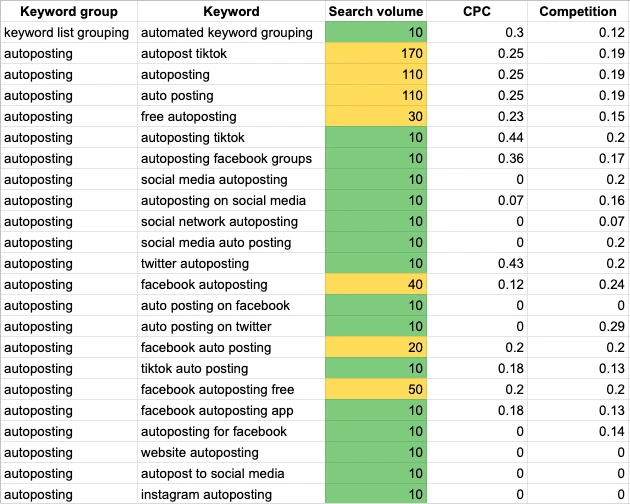
Ahrefs is a commonly used keyword research tool
Keyword research tools are indispensable for gathering data-driven insights and discovering new keyword opportunities. Here are 4 popular tools you can test out:5. Google Keyword Planner: Google's free tool provides keyword suggestions, search volume data, and competition insights. This is a suitable solution for both SEO beginners as well as experienced experts.
6. SEMrush: SEMrush offers comprehensive keyword research features – including competitor analysis, keyword difficulty assessment, and new trend analysis. Thereby, you can identify profitable keyword opportunities, get detailed data to make informed business/communication decisions.
7. Ahrefs: No one doing SEO is unfamiliar with Ahrefs – outstanding in its ability to provide rich keyword data, backlink analysis, competitor research, keyword difficulty, search volume and click-through rate, etc.
8. Moz Keyword Explorer: Moz's tool offers a range of keyword research features, including keyword suggestions, search volume, and difficulty metrics. Additionally, users can access insights into organic CTR (click-through rate) as well as explore long-tail keyword opportunities.
9. AnswerThePublic: Used to draw content maps (following the Flywheel model). It helps you see exactly what questions users are typing around AI, shopping or social networking topics.
10. Allintitle: Extremely essential when working on platforms other than Google. This syntax helps you properly filter data sources on e-commerce platforms (Amazon, eBay) or AI search engines (like Perplexity).
Adapt to new trends and Local SEO
During keyword research, businesses need to always pay attention to seasonal fluctuations and emerging trends in the industry. Certain keywords may fluctuate in search volume throughout the year. By identifying seasonal keywords and integrating them into your implementation strategy, you'll be able to take advantage of traffic opportunities during these times of the year.
Additionally, if your business operates/offers services in specific geographic areas, consider incorporating localized keywords into the research process. These keywords are characterized by containing information about a city, region or country targeting users searching for products/services in a specific location. Implementing local keyword research will contribute to improving the relevance of keywords, increasing the opportunity to attract local customers.
Steps to conduct effective keyword research
Step 1: Brainstorm related topics & Choose seed keywords
Start by making a list of broad topics related to your industry, product or service. Among them, identify the core topics that are relevant to your business.
Example #1: If you are the owner of an e-commerce website selling organic skin care products, you can start with topics like: natural skin care, organic beauty, sustainable cosmetics.Example #2: If you are the owner of a study abroad consulting company, you can start with topics such as types of study abroad (eg: studying abroad at university level/master's level/vocational study abroad/summer studying abroad/exchange study abroad), popular countries (eg: studying abroad in the US, studying abroad in Australia...), types of consulting services (eg: finding a school to study abroad, making a study abroad application, applying for a visa, visa interview practice, finding housing, consulting on choosing a major to study abroad), and target audience. customers (eg: studying abroad for high school students/students/working people), or related side information (eg: host family; SAT test; welcome to go abroad…)
Step 2: Expand keyword ideas
Once you have identified broad topics, you will need to expand your keyword ideas by category as follows:
- Synonyms & related terms: Identify synonyms and related terms for your main keywords. This will help you expand your reach – as well as capture different user search variations.
- Industry Jargon: Incorporate jargon and industry-specific terms that your target audience might use when searching for information or products in your niche.
- Location-based keywords: If your business operates in a location or targets a specific geographic area, try to tailor your keyword set to include information about that area. For example: “Hanoi skin care” or “District 1 cosmetics”.
- Keywords based on user intent: You need to consider the intent behind users' searches and develop keywords that suit their specific needs. This includes keywords that indicate informational intent (e.g., “how to choose organic skin care products”), transactional intent (e.g., “buy organic facial cream”), or navigational intent (e.g., “best organic skin care brands”).
Step 3: Analyze search volume and competition level
Use keyword research tools to collect data on search volume and competition for selected keywords - from there, plan to prioritize keywords with high demand and a reasonable level of competition. During the keyword research process, you need to remember to ensure a balance between relevance and practical implementation.
Additionally, looking at Search Volume (SV) alone is not enough. Many keywords look great in terms of volume but the traffic they bring in is flat, while there are keywords that are moderate in volume but the total traffic they get is extremely large.
That's why Ahrefs' Traffic Potential (TP) index (the actual total traffic that the Top 1 site receives) is much more accurate when researching keywords.
Real-life example: The keywords "sales page" and "submit website to search engines" have equal Search Volume. However, the Top 1 article for the word "submit website to search engines" covered 406 sub-keywords and pulled in 5 times more traffic than the Top 1 article for the word "sales page" (which only followed about 55 keywords).
Takeaway: An SEO standard article not only eats the main keyword, but it also entails a bunch of related secondary keywords (long-tail keywords).
Step 4: Determine priority keywords
Based on the insights gained from analyzing search volume and competition, you need to prioritize your keyword list. Prioritize keywords that closely align with your business goals, have significant search volume, and are reasonably competitive. These keywords should be the main focus for optimization (SEO).
Step 5: Refine the keyword listThe purpose of list refinement is to ensure you optimize your efforts and target the most valuable keywords. You can follow these 2 steps:
- Filter irrelevant keywords: Remove any keywords that aren't directly related to your business, products, or target audience. Focus on keywords that are closely related to your business's products/services and are more likely to attract quality traffic.
- Evaluate keyword difficulty: Evaluate the difficulty of each keyword based on competitive analysis. You need to consider factors such as: domain authority (DA), backlink profile (backlink profile) and content quality of the Top 10 ranking pages. From there, select keywords that have a realistic chance of ranking.
Step 6: Conduct keyword classification and mapping (keyword mapping)
After collecting a list of potential keywords, the next step is to classify them based on relevance, search volume, and competition level. Categorize keywords into primary, secondary, and long-tail keywords. Primary keywords are the main focus and represent broad topics, while secondary/long-tail keywords give you the opportunity to target users more specifically.
4 types of keyword intent (Source: Semrush)
The keyword mapping process requires you to identify target keywords for specific content pages on the website. By choosing the right keywords for your content, you'll ensure that each page is optimized for specific queries, improving search engine visibility and user experience. During this process, you need to consider the search intent behind each keyword and “map” it to the most suitable landing page.
Example of keyword research in practice
Example 1: E-commerce website selling organic skin care products
The following is a case study of an e-commerce website that specializes in selling organic skin care products. After brainstorming topics like: natural skin care, organic beauty, and sustainable cosmetics, we can expand on keyword ideas like “chemical-free facial cream,” “non-toxic makeup brands,” or “sustainable skin care routine.”
Analysis of search volume and competition shows high demand for keywords like “organic skin care products” and “natural beauty brands” with moderate competition.
Example 2: Digital agency targets small businesses
Let's say a digital agency aims to reach small businesses. After identifying topics like social media marketing, search engine optimization (SEO), and content strategy, we can expand on keyword ideas like “cheap SEO services ,” “local social media management,” or “effective content marketing.”
Search volume and competition analysis shows moderate demand for keywords like “cheap SEO services” and “local social media marketing” with high competition.
How to do keyword research with ChatGPT
Did you know that ChatGPT can assist you in brainstorming and finding ideas for keyword research? While it doesn't have direct access to keyword research tools or real-time data, ChatGPT can provide valuable suggestions and insights based on its vast data source.You can ask ChatGPT to generate keyword variations, discover trending keywords, or suggest keywords related to your industry/target audience. Here are some suggestions to help you conduct keyword research with ChatGPT:
- “Create a list of long-tail keywords for [your industry or niche] that target specific customer needs and pain points.”
- “Provides keyword suggestions to optimize content around [topic] to improve search engine visibility and attract relevant traffic.”
- “Discover trending keywords in [your industry].”
- “Create a list of local keywords to target [specific location] and attract the attention of local customers in [your industry].”
- “Suggest alternative keywords or synonyms for [main keyword] to diversify your keyword strategy and reach a wider audience.”
- “Identify high-value keywords with low competition in search engine rankings.”
- “Make a comprehensive list of relevant keywords and variations for [your product or service].”
- “Provides insight into the search intent behind certain keywords.”
- “Helps identify long-tail keywords with a combination of high search volume and low competition.”
Remember to validate generated ideas using external keyword research tools and analytics data to make the right decisions
Conclusion
Mastering keyword research methods is a necessary requirement for success in the field of digital marketing in general and SEO in particular. By understanding the key components of keyword research, developing a comprehensive strategy, and following the guided steps above, you can uncover valuable queries that drive targeted traffic to your website and improve your online visibility.
FAQ ( Frequently Asked Questions )
How can ChatGPT be applied to the keyword research process?
ChatGPT is very helpful in brainstorming and expanding keyword ideas. You can use prompts to ask ChatGPT to create a list of long-tail keywords that address customer pain points, discover new trends, suggest local keywords, or analyze the search intent behind certain keywords. However, because ChatGPT does not have direct access to real-time measurement tools, you are required to validate these suggestions with keyword research tools (like Ahrefs, SEMrush) before applying.
What is Keyword Clustering and why should you apply it?
Keyword Clustering is the process of grouping closely related search queries together under a Parent Topic. Today's search engines are smart enough to understand that different keyword variations (like "coffee sponge" and "how to make sponge coffee") actually have the same search intent (Search Intent). Thanks to that, a website can completely rank for hundreds, even thousands of similar keywords at the same time. By grouping these related keywords, you can target dozens of long-tail keyword variations with just one in-depth and quality article, instead of wasting time creating tons of separate pages causing duplicate content.
Should you target "Zero Search Volume" keywords?
The answer is yes. Targeting keywords with low or zero volume (Zero Volume Keywords) is actually an extremely effective strategy. The Search Volume index on SEO tools is only an estimated annual average, so it often underestimates the actual traffic potential of emerging or seasonal trending topics. Keywords displaying Search Volume as 0 are often extremely specific queries (deep niches) so it is easy to get to the Top. If you deploy quality content for about a hundred niche keywords like this, the total amount of Organic Traffic collected every year can be completely small, bringing thousands of actual visits.